Falmouth Docks Redevelopment
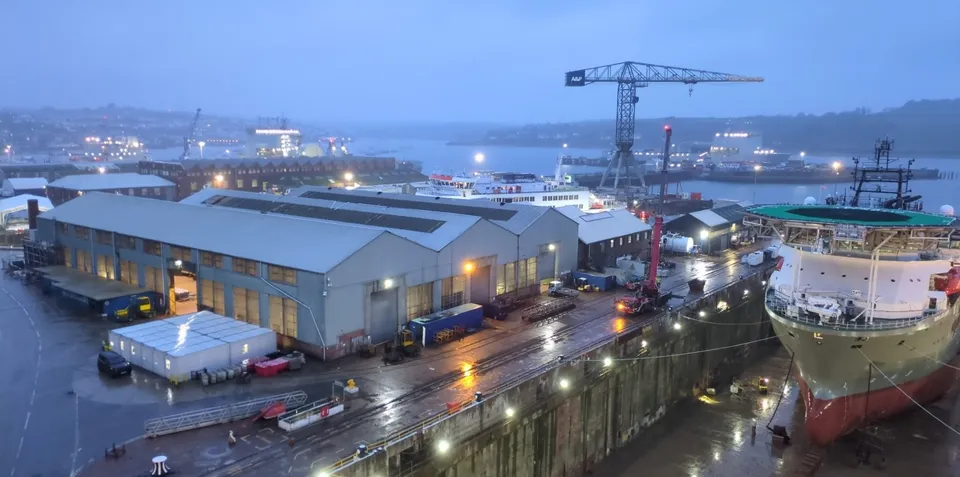
The proposed redevelopment has been described as the largest in Falmouth in 80 years. Plans include extensive dredging, construction and waste disposal. The development aims to increase both the number and size of cruise ships, as well as increasing military and industrial use. It may also allow the storage and assembly of offshore wind turbines.
However, the development is expected to cause sediment and toxic substances to spread. This threatens fisheries and sea life, including rare maerl and seagrass habitats, and marine mammals.
Take Action
Learn more about the plans via the info and links on this site, and consider taking action:
Find out more
If you want to learn more about the plans to redevelop Falmouth Docks, checkout these links:
The full planning application and residents' comments can be viewed through the planning portal at Cornwall Council (PA25/01598).
You can find the marine licensing application on the MMO website (MLA/2025/00157).
Have your say
We think that these plans will transform our town, and people have a right to know about them.
If, having read through the links on this website, you object to the plans, please comment on the Cornwall Council planning portal and contact your councillor with your concerns. You can find your councillor's details here.
The plans could go before Cornwall Council's Strategic Planning Committee at the next meeting so you should also contact each member of the Strategic Planning Committee with any concerns above the waterline.
Click on the blue boxes below for a template letter, information on the planning process and key contacts to help you get started.
What to include in a letter and consider for a phone call / conversation
Please put this in your own words if you can - it need not be as formal or detailed as suggested below. But try not to overthink it - it is important to have registered your concern with the decision makers prior to the decision date.
Who are you writing to?
Dear Councillor / Cornwall Council Strategic planning committee,
First paragraph (suggest 5 sentences):
What are you writing about? (brief summary)
I am writing to express concern / offer feedback on the proposed works at Falmouth Docks (planning ref. PA25/01598, marine licensing ref. MLA 2025 00157).
Why are you writing to them?
I am contacting you about this issue as my local councillor / as a member of the committee who will determine Cornwall Council's decision on this application.
What is your understanding of the application? (brief summary)
I understand that the application involves dredging the sea bed in an area of the docks containing toxic substances, and construction work, to allow for a major expansion in cruise tourism, maintenance and repair facilities for military and commercial applications, and the potential for supporting the floating offshore wind industry. I also understand that the use of Falmouth Docks for floating offshore wind is yet to be confirmed.
What would you like them to do?
I ask that you represent my concerns to the decision-makers and request that the application is not approved while these concerns are unresolved / that you represent my concerns and vote against the application proceeding while these concerns are unresolved, and encourage other committee members to vote similarly.
Second paragraph (suggest 2-5 sentences):
Who are you and how will you be affected personally?
I am a local resident (where?) / local worker (where?) / local business owner (which one?) / nature lover / sea swimmer / watersports enthusiast / member of a relevant group (which one?) / person with relevant expertise (what?). If the proposal goes ahead, I will be personally affected by the impacts on the environment / impacts on health / increased cruise tourism / traffic / noise / demands on local infrastructure.
(Optionally) How will people / things you know be affected?
I am also concerned about the effects on a specific friend (who?) / group of people (who?) / part of our natural environment or cultural heritage, due to the (describe the expected effects).
(Optionally) Did you find out about this from Falmouth Docks / Cornwall Council and when?
I was informed about the proposals by Falmouth Docks / Cornwall Council on (when?).
OR
I have not been informed by Falmouth Docks or Cornwall Council about this application.
Subsequent paragraphs:
Explain what else you are sharing:
In the rest of this letter, I offer more detail on my concerns, then conclude with a summary paragraph.
Detail your concerns:
You might find it helpful to refer to the key points section below titled "Environmental", "Social" and "Economic". Note that the decision on works below the water (e.g. the dredging work) rests with the Marine Management Organisation (MMO). So it is best to focus any asks of Cornwall Council on the above water environmental issues, and the social and economic impacts. You could also ask them to represent concerns on below water issues to the MMO.
Summary paragraph:
(Optionally) Brief summary with a bit of passion / emphasis of importance and urgency
The proposed development poses real and substantial risks to our highly precious, unique and irreplaceable natural environment, sustainable fishery and local heritage, and I sincerely hope you will treat this with the care and consideration it deserves.
Repeat the ask
As I outlined earlier, please will you represent my concerns to the decision-makers and request that the application is not approved while these concerns are unresolved/ that you represent my concerns and vote against the application proceeding while these concerns are unresolved, and encourage other committee members to vote similarly.
Invite further conversation
I would be grateful if you could respond to let me know the actions you have taken or will take, and if I can support you further with these.
Signing off
Yours Faithfully / Yours Sincerely / Yours Truly / Thank you / Thank you for your consideration
Include your name
(optionally - include membership of relevant groups or details of relevant roles and expertise)
(optionally - include your address - this is necessary if writing to your MP)
Further actions
Please click on the blue boxes below for details on the planning process and key contacts, to decide who to share your concerns with.
It is best if you can also submit your concerns to the Cornwall Council Planning portal, where they will be public and should also be considered by all Cornwall Council decision makers. This could simply be a copy of a letter, with personal details removed.
Cornwall Council advise that it is best if your comments are about relevant material planning considerations and not of a personal nature. If you have the time, please relate your comments to the relevant planning comments described in the table here. See the section below on Leaving a Public Comment for instructions.
The decision on the Falmouth Docks redevelopment proposal currently rests with the Marine Management Organisation (MMO) for the marine licensing of the works happening beneath the water (particularly the dredging and underwater construction), and with Cornwall Council for the works above the water.
There are general contact details for the MMO on their website. It is best to include the marine licensing application reference number when you get in touch, which is MLA 2025 00157. You could also ask Cornwall Council to put you in touch with the MMO or represent your concerns to them.
Details of the key Cornwall Council decision makers and contacts are available on the Cornwall Planning Portal. The relevant planning application reference number is PA25/01598. The planning case officer is named as Mark Ball, and the contact is listed as the ward councillor - Cllr. Laurie Magowan (cllr.laurie.magowan@cornwall.gov.uk). Cornwall Council's decision rests with these two individuals in the first instance. Either one of them can request that it comes to a planning committee for consideration, where a vote will be taken.
The application was temporarily included in the agenda for the Cornwall Council strategic planning committee on 26th July. It was subsequently withdrawn. It may come to an upcoming meeting of that committee. The agendas and dates for the meetings of this committee are published here. At the bottom of that page there is a link to register to speak at these meetings.
A list of members on the strategic planning committee is available on the Cornwall Council website. You can find their contact details here. You can also find the details for your local Cornwall councillor here.
- Cornwall Council: planning@cornwall.gov.uk
- Cornwall Council Strategic Planning Committee - Contact details
- Cornwall Council Central Sub-Area Planning Committee
- Marine Management Organisation - marine.consents@marinemanagement.org.uk
- Cornwall Councillor for Arwenack Ward Laurie Magowan - cllr.laurie.magowan@cornwall.gov.uk
- Find your local Cornwall Councillor
- MP for Truro and Falmouth Jayne Kirkham - jayne.kirkham.mp@parliament.uk
To leave a public comment please visit the Cornwall Council Planning Portal and Log In:
- This will require you to create an account, if you do not have one already.
- Once logged in, you can search for the planning application (PA25/01598).
- Next, click the box with the blue rectangular speech mark and the words "Make a comment".
- There is then a form to complete - most of the required fields should be filled in already - the most important ones to complete are "Commenter Type" (choose from the drop-down), "Stance" (tick one of Object, Support or Neutral), and "Your Comment" (describing your concerns).
Key points and suggestions
- The risk to marine life due to the spreading of sediment is too high
- This threatens rare habitats such as maerl and seagrass, sustainable and natural fisheries, and marine mammals.
- Sediment contains toxic substances, including biocides (TBT) and carcinogens (PAHs and PCBs).
- Issues may be caused by dredging, construction work, and dumping waste at sea.
- Could dredging be avoided by keeping larger cruise ships out at sea and ferrying passengers in?
- Firmer commitments for environmental monitoring and mitigations during construction.
- Curtains should be used to minimise sediment spread from construction and dredging work.
- Levels of sediment and toxic substances should be continuously measured throughout the areas where sediment will spread, and works stopped immediately if these exceed safe thresholds.
- The impacts on sea life should be continuously monitored.
- Construction works should be stopped if sea life deteriorates.
- Fair compensation should be provided for deterioration of sea life due to the works and subsequent activities.
- Air pollution impacts of construction traffic should be monitored and fair compensation provided.
- Firmer commitments for environmental monitoring and mitigations of future activities.
- The proposal includes ambitions to massively expand cruise ship numbers to 200,000 passengers a year (from 55,000 passengers in 2025), and to grow maintenance and repair capabilities (e.g. for military contracts), and cargo business.
- There should be monitoring of the sources of pollution caused by this: air pollution, sewage, waste, toxic substances, noise and light.
- This includes the on-land pollution due to cruise passenger tourists, e.g., from coach travel.
- The negative impacts of this pollution should be evaluated and compensation provided.
- Floating Offshore Wind can have environmental benefits if combined with a reduction in less environmentally friendly energy generation.
- There should be more evaluation of which Floating Offshore Wind activities are most appropriate for Falmouth Docks, and these activities should be prioritised.
- Preparing Falmouth Docks for Floating Offshore Wind should not be dependent on expanding cruise ship or other industrial capacity.
- The proposal includes ambitions to massively expand cruise ship numbers to 200,000 passengers a year (from 55,000 passengers in 2025), and to grow maintenance and repair capabilities (e.g. for military contracts), and cargo business.
- There has been inadequate consultation with local residents for a development of this size.
- The traffic impacts are overbearing:
- Construction traffic transporting materials to the docks and waste from the docks.
- Cruise passenger traffic for day-trips (coaches, shuttle buses, taxis).
- Limits should be set on the volume of traffic, and compensation provided for congestion impacting on residents and discouraging visitors.
- The negative impacts on local peoples' health and livelihoods should be minimised, with fair compensation provided. Impacts may be due to:
- air and sea pollution
- economic disruption
- change in cultural heritage.
- There should be an independent economic impact assessment.
- The current assessment uses figures from the cruise industry; scientific studies have shown these to routinely overestimate local economic benefits.
- Negative economic impacts on fishing and tourism should be monitored and fair compensation provided.
- The quality of jobs supported should be evaluated and minimum standards should be raised.
- Will jobs be seasonal or year-round?
- Will they be for local residents?
- What will the working conditions be like?